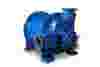
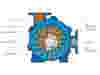
The design technology behind liquid ring vacuum pumps is advanced to achieve optimum, reliable performance for the rigorous demands of harsh industrial environments. Liquid ring vacuum pumps are an economical and robust solution engineered to meet specific customer requirements.
Condensation Of Vapors Can Yield A Capacity Bonus
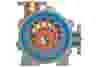
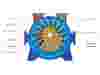
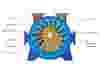
Dry air or a dry gas mixture is compressed from vacuum to atmospheric pressure in a liquid ring pump much the same way as it would be in any other displacement type pump, except that there is less of a temperature rise of the gas stream through the pump.
Humid air or gas mixtures containing condensable vapor behave quite differently. Some of the vapor that enters a liquid ring pump condenses when it is cooled by the lower temperature seal liquid. The condensate mixes with the seal liquid. Now, it occupies a much-reduced space as contrasted with its former volumetric dimension when it was a component of the inlet gas stream. This volumetric reduction becomes a capacity bonus.
The only vapor that can be condensed early enough to escape compression contributes to the inlet capacity bonus. In each rotor chamber, the condensation must occur before that chamber passes its inlet port. Any condensation that occurs after the cutoff will not have an effect on pump inlet capacity.
Liquid ring vacuum pumps can handle large amounts of liquid through its inlet port with a negligible reduction of gas capacity. To maximize the condensation bonus some of the liquid is often sprayed into the inlet piping, upstream of the vacuum pump itself.
Global Provider
Backed by over 110 years of experience, NASH CERTIFIED experts provide aftermarket support with maintenance, service, parts, and repair. Service centers are globally located to protect your vacuum system investment and provide quality, reliable, and efficient solutions.